
Do Chinese Cars Hold Their Value in the UAE? A 2026 Resale Reality Check
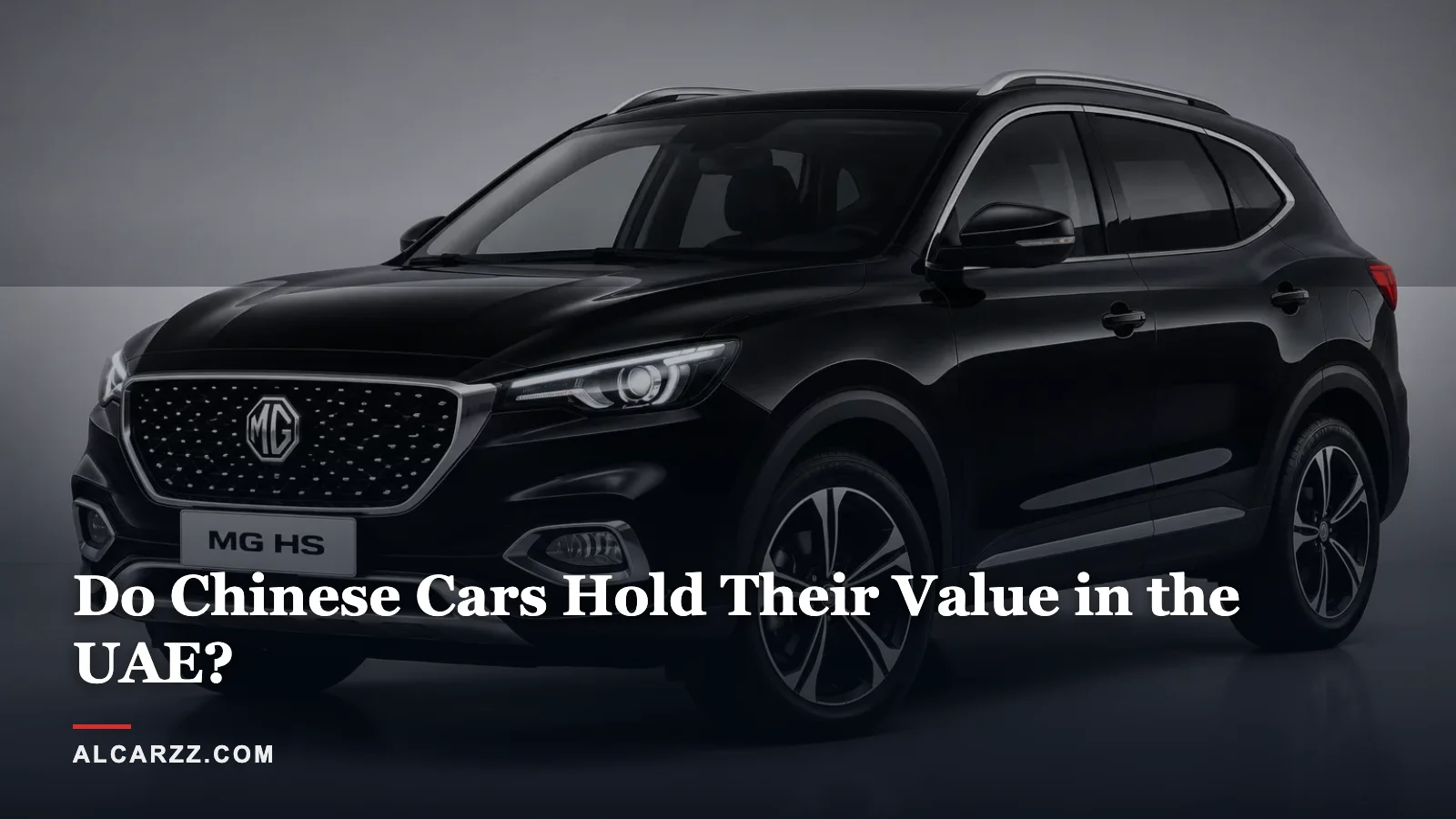
Chinese brands have already won the new-car argument in the UAE. The used-car argument is still being fought — and that is where buyers lose money. The showroom saving is real and often substantial. Whether you keep it depends entirely on how long you hold the car and which nameplate you chose. This is an honest look at what the resale numbers actually say in 2026, without brand loyalty in either direction.
Key takeaways
- Chinese vehicles in the UAE typically depreciate around 30–40% in the first two years, steeper than established Japanese equivalents.
- Market analysis suggests a two-year-old Chinese SUV may retain roughly 45% of its value where a comparable Japanese model retains closer to 70%.
- The gap is narrowing for established nameplates. The MG HS is reported to hold roughly 55–60% after three years — approaching mainstream territory.
- Sales volume predicts resale. High-volume models build parts confidence and buyer familiarity; slow-selling variants do not.
- The decisive variable is holding period. Keep the car seven or eight years and the purchase saving is genuinely yours. Sell at three and much of it transfers to the next owner.
What this guide covers
- What the depreciation numbers actually show
- Why the gap exists
- Brand by brand: where each stands
- What is closing the gap
- The maths: when a Chinese car is the cheaper choice
- How to protect resale value if you buy one
- Buying a used Chinese car
- Expert verdict
- FAQ
What the depreciation numbers actually show
Reported UAE market analysis puts first-two-year depreciation for Chinese vehicles in the region of 30–40%. The comparison that matters is relative: a two-year-old Chinese SUV retaining around 45% of original value against roughly 70% for an equivalent Japanese model represents a meaningful transfer of wealth from the first owner to the second.
A concrete illustration frequently cited in the Dubai used market: a 2022 Chery Tiggo 8 originally listed near AED 89,000 has been trading in the region of AED 38,000–42,000. That is roughly 45% retention after three years or so — consistent with the pattern, and a useful reality check against showroom optimism.
| Scenario | Chinese SUV | Japanese equivalent |
|---|---|---|
| Purchase price | AED 90,000 | AED 120,000 |
| Purchase saving | AED 30,000 in the buyer's favour | |
| Indicative value after 2 years (45% vs 70%) | ~AED 40,500 | ~AED 84,000 |
| Value lost over 2 years | ~AED 49,500 | ~AED 36,000 |
| Net position vs the Japanese car | Chinese buyer ahead by roughly AED 16,500 | |
An illustrative model using reported retention rates, not a quotation. Actual values depend on model, condition, mileage, service history and market timing — confirm live valuations before making a decision.
Note what this model shows: even with steeper depreciation, the Chinese buyer is still ahead in cash terms, because the saving was larger than the extra depreciation. The percentage looks alarming; the dirham outcome is more favourable than the headline suggests. That distinction is the single most misunderstood point in this debate.
Why the gap exists
Resale value is a confidence market. Four factors drive the discount:
- Track record. Used buyers pay for predictability. A nameplate with fifteen years of UAE service history is a known quantity; a three-year-old brand is not.
- Parts availability. The second owner is buying future repair costs as much as a car, and worries about lead times on components.
- Service network depth. A brand with workshops in every emirate supports resale in a way that a two-city network cannot.
- Volume and familiarity. A model that sold in numbers has an active used market with real price discovery. A rare variant has neither.
Note that none of these are engineering criticisms. Build quality, equipment and safety in current Chinese product are broadly competitive — the discount reflects market confidence and infrastructure, not necessarily the metal. That is why the gap can close relatively quickly as brands mature.
Brand by brand: where each stands
| Brand | UAE resale position | What is driving it |
|---|---|---|
| MG | Strongest of the group | Longest UAE presence; the MG HS reported around 55–60% retention after three years |
| Chery | Mixed, model dependent | Tiggo 8 volume supports its market; niche variants do not |
| BYD | Improving | Global EV scale and technology credibility |
| Geely | Improving | Dealer investment and certified pre-owned programmes |
| Haval | Establishing | Strong new-car sales; used data still maturing |
| Jetour | Establishing | Rapid 2026 growth; limited used history so far |
| Changan | Establishing | Growing network, thinner used-market depth |
The pattern is consistent: time in market predicts resale better than badge origin does. MG's advantage over Jetour is not primarily engineering — it is a decade of UAE presence, service coverage and used-market liquidity. Jetour's current momentum, covered in our Jetour T2 buyer's guide, is exactly what builds that history — but it takes years to show up in residuals.
What is closing the gap
Several developments are working in buyers' favour:
- Extended transferable warranties. The word "transferable" is doing the heavy lifting — a warranty that follows the car to its second owner directly supports resale.
- Certified pre-owned programmes that put a manufacturer's name behind used stock.
- Denser dealer and workshop networks across all seven emirates.
- Sheer familiarity. As these cars become ordinary on Sheikh Zayed Road, the perceived risk of buying one used falls.
These are the factors to interrogate at the dealership, because they are the ones that will determine your trade-in value in four years.
The maths: when a Chinese car is the cheaper choice
The decision reduces to a single question: how long will you keep it?
| Holding period | Verdict | Reasoning |
|---|---|---|
| 1–2 years | Avoid | Steepest part of the depreciation curve; the saving does not have time to work |
| 3–4 years | Marginal | Roughly break-even; depends heavily on model and condition |
| 5–7 years | Favourable | Purchase saving outweighs the extra depreciation |
| 8+ years | Clearly favourable | All cars converge toward low residuals; you keep the saving |
If you change cars every two years, buy the established brand — the resale gap will cost more than the purchase saving. If you buy and keep, the value case is strong and getting stronger. For long-hold buyers, our guide to the most reliable cars in the GCC after 100,000 km is the more relevant filter, and the real cost of owning a car in the UAE puts depreciation alongside the other running costs.
How to protect resale value if you buy one
- Buy a high-volume model, not a niche variant. Volume creates a used market; rarity destroys one.
- Confirm the warranty is transferable and get it in writing.
- Service exclusively at the authorised dealer and keep every record. Full agency history is worth more on a newer brand than on a Toyota.
- Choose conservative colours. White and silver sell fastest in this market.
- Stay stock. Modifications reduce the buyer pool and can create registration problems.
- Protect the paint and interior. UV damage is the fastest route to a low valuation in the Gulf.
- Sell before the warranty expires if you are selling at all — a transferable warranty with time remaining is a genuine selling point.
Our resale value checklist covers presentation in more detail, and servicing intervals for Gulf conditions explains why documented maintenance matters so much here.
Buying a used Chinese car
Everything above inverts if you are the second owner. The steep first-owner depreciation is precisely what makes a two or three-year-old Chinese SUV one of the strongest value propositions in the UAE market — a well-equipped, low-mileage vehicle at a fraction of its original price.
Three checks before you buy: confirm remaining transferable warranty, verify full agency service history, and establish parts availability for that specific model. Then follow the standard process in our used car buying guide and verify history using our guide to checking accident records. Compare candidates on our comparison tool, check new car listings and current offers to benchmark the discount, and model finance on our EMI calculator.
Expert verdict
The blunt version: yes, Chinese cars depreciate faster in the UAE, and no, that does not automatically make them a bad purchase. Those two statements are not in conflict, and most of the argument on this topic comes from people holding only one of them.
The percentage figures are genuinely worse. The dirham outcome frequently is not, because the purchase saving is large enough to absorb the extra depreciation — provided you hold the car long enough for that arithmetic to work. Five years or more and the value case is sound. Two years and you are paying for the privilege of the discount.
Buyers who want the lowest-risk outcome and change cars frequently should still buy established Japanese or Korean metal. Buyers who keep cars until they are genuinely old are, on current numbers, better served by the newcomers than conventional wisdom suggests. And the best-positioned buyer of all is the one shopping used — collecting someone else's depreciation at a discount, with warranty still attached.
Frequently asked questions
Do Chinese cars hold their value in the UAE?
Less well than equivalent Japanese models. Reported UAE data suggests roughly 30–40% depreciation in the first two years, with a two-year-old Chinese SUV retaining around 45% of value against approximately 70% for a Japanese equivalent. Established nameplates like the MG HS perform better, at a reported 55–60% after three years.
Which Chinese car brand has the best resale value in the UAE?
MG currently leads, largely because of its longer UAE market presence, denser service network and established used-market liquidity. Chery performs reasonably on high-volume models such as the Tiggo 8, while newer entrants are still building resale history.
Is buying a Chinese car in the UAE a financial mistake?
Not if you keep it. Because the purchase saving is usually larger than the additional depreciation, buyers holding five years or more are typically ahead in cash terms. Buyers changing cars every two to three years are better served by an established brand.
Why do Chinese cars depreciate faster in the UAE?
Mainly market confidence rather than engineering. Shorter track records, uncertainty about parts availability, thinner service networks and lower used-market familiarity all compress what second buyers will pay — factors that improve as brands mature locally.
Should I buy a used Chinese car in the UAE?
It can be one of the strongest value buys in the market, since the first owner has absorbed the steepest depreciation. Confirm remaining transferable warranty, insist on full agency service history and check parts availability for that specific model before committing.
Does a transferable warranty affect resale value?
Yes, significantly. A warranty that passes to the second owner reduces their perceived risk and directly supports the price you can achieve. Always confirm transferability in writing at purchase rather than assuming it.