Car Ownership Transfer in the UAE 2026: Seller's Guide to Fees, Salik and Liability
You sold the car, took the money, handed over the keys — and three weeks later a Salik charge and a speeding fine land on your Emirates ID. This is one of the most common and most expensive misunderstandings in the UAE used-car market, and it stems from a single legal fact: until the RTA issues a new Mulkiya in the buyer's name, the car is still yours. This guide walks through the 2026 transfer process from the seller's side, and how to close the liability gap.
Key takeaways
- Ownership does not transfer when money changes hands. It transfers when the RTA issues a new Mulkiya — everything before that moment is legally on the seller.
- Between handover and registration, every Salik deduction, traffic fine, parking violation and accident liability sits with the seller.
- The 2026 Dubai transfer fee is commonly quoted at AED 350, with a broader range of roughly AED 350–500 depending on vehicle type and weight.
- Expect additional line items: vehicle inspection around AED 170 and number plates from roughly AED 35 to AED 500 depending on plate type.
- As of 2026, the final transfer still requires both parties physically present, or a notarised power of attorney. Budget 30–60 minutes at a typing centre with documents in order.
What this guide covers
- The liability gap: why sellers get caught
- Documents the seller must bring
- The transfer process step by step
- Fees and costs in 2026
- Salik: what to do with your tag
- What blocks a transfer
- How to protect yourself as a seller
- If you are the buyer
- Expert verdict
- FAQ
The liability gap: why sellers get caught
Under UAE law the registered owner carries responsibility for the vehicle. That responsibility is tied to the Mulkiya, not to who is physically driving or who has paid for the car. Until the transaction is completed at the RTA and a new registration card is issued, the vehicle remains tied to the seller's Emirates ID.
The practical consequences during that window are significant:
- Salik. Every gantry the buyer passes deducts from the account linked to that vehicle.
- Traffic fines. Speeding and red-light violations register against the seller's record, and in some cases against their licence.
- Parking violations. Issued to the registered owner.
- Accidents. This is the serious one. If the buyer has an accident before transfer, the seller's insurance and legal position are directly exposed.
The gap opens because of an entirely understandable sequence: buyer and seller agree a price, the buyer pays, takes the car, and both agree to "sort the paperwork this week." That week is where the risk lives. The rule that protects you is simple and non-negotiable: do not hand over the keys until the transfer is complete.
Documents the seller must bring
| Document | Requirement | Common pitfall |
|---|---|---|
| Original Emirates ID | Must be valid and unexpired | Expired ID stops the process entirely |
| Original Mulkiya (registration card) | Original, not a copy or photo | Lost card requires a replacement first |
| Valid insurance in the seller's name | Must be current at time of transfer | Policy cancelled early by the seller |
| Clear fines record | All traffic fines settled | Unpaid fines block the transaction |
| Signed sale agreement | Both parties, with vehicle details | Vague or verbal-only agreements |
Requirements and fees are those commonly published for Dubai in 2026. Other emirates operate their own authorities and may differ. Always confirm current requirements on the official RTA channels before travelling to a service centre.
The transfer process step by step
- Settle every outstanding fine. Check the RTA and Dubai Police systems for both traffic fines and any impound or Salik arrears. Nothing proceeds until these clear.
- Agree terms in writing. A short signed sale agreement listing chassis number, plate, price, date and both parties' details prevents most later disputes.
- Complete the vehicle inspection if required for the vehicle's age and category. Budget around AED 170.
- Buyer arranges insurance in their own name. The RTA will not register the vehicle to the buyer without it — this is the step that most often delays a same-day transfer.
- Both parties attend the RTA service centre or approved typing centre. Bring originals, not copies.
- Pay the transfer fee and any plate charges.
- New Mulkiya is issued in the buyer's name. This is the moment ownership actually changes.
- Only now hand over the keys — and retain a copy of the new registration card for your records.
With documents in order the process typically takes 30 to 60 minutes at a typing centre. The delays that stretch it into days are almost always unpaid fines or the buyer's insurance not being ready.
Fees and costs in 2026
| Item | Indicative cost (AED) | Paid by |
|---|---|---|
| Ownership transfer fee | 350 (range approx. 350–500 by vehicle type and weight) | Usually buyer, negotiable |
| Vehicle inspection | Approx. 170 | Usually seller |
| Number plates | 35–500 depending on plate type | Buyer |
| New insurance policy | Varies by vehicle and driver | Buyer |
Who pays what is a matter of negotiation rather than regulation, so settle it when you agree the price rather than at the counter. For a fuller picture of what a policy will cost the buyer, see our guide to comprehensive versus third-party car insurance in the UAE.
Salik: what to do with your tag
Salik is one of the most persistent sources of post-sale friction. The toll tag is linked to the vehicle, and charges will continue accumulating against the linked account if the tag is not deactivated or transferred. Sellers regularly discover this weeks later.
Three practical steps:
- Note your Salik balance and account status before the sale.
- Deactivate or transfer the tag as part of the transfer process, not afterwards.
- Check your Salik statement two to three weeks after the sale to confirm no further deductions are appearing.
Outstanding Salik balances can also cause a registration block, which means an unresolved account does not simply cost money — it can stop the transaction outright.
What blocks a transfer
- Unpaid traffic fines on the vehicle or the seller
- Outstanding Salik balance
- An active bank loan or mortgage on the vehicle — the financing must be cleared and the lender's release obtained
- Illegal modifications. Vehicles with non-compliant modifications can face registration blocks; anything altered from stock should be returned to standard before sale
- Expired insurance or Emirates ID
- Failed or missing inspection
The loan point deserves emphasis. If the vehicle was financed, the bank holds an interest that must be formally released. Start that process well before you advertise the car — it is measured in days, not hours. Our guide to UAE car loans and financing covers how these arrangements are structured.
How to protect yourself as a seller
- Never release the vehicle before the new Mulkiya is issued. This single rule eliminates the majority of seller risk.
- Refuse "I will transfer it next week." There is no version of this arrangement that protects you.
- Keep your insurance active until transfer completes — cancelling early creates both a legal gap and a blocked transaction.
- Photograph the odometer and vehicle condition on handover day.
- Keep the signed sale agreement and a copy of the new Mulkiya for at least a year.
- Check your fines record two weeks later to confirm nothing new has attached to your ID.
- If using a power of attorney, ensure it is properly notarised — an informal authorisation letter will not be accepted.
Sellers preparing a car for market should also read our 10 proven tips to increase resale value before selling, which covers presentation and service history — the two things that most affect the price you achieve.
If you are the buyer
The same process protects you in mirror image. Do not pay in full before the transfer is arranged, and do not accept a car whose registration cannot be transferred on the day. Before agreeing a price, verify the vehicle's history — our guide to checking a car's accident history explains how, and our used car buying guide covers inspection.
Also confirm the vehicle is GCC specification, which affects both insurance and future resale — we explain why in why GCC specifications matter. If you are replacing the car rather than simply selling, browse current new car listings, compare shortlisted models on our comparison tool, check live offers and model the finance on our EMI calculator. Current market pricing is tracked on our UAE car prices page.
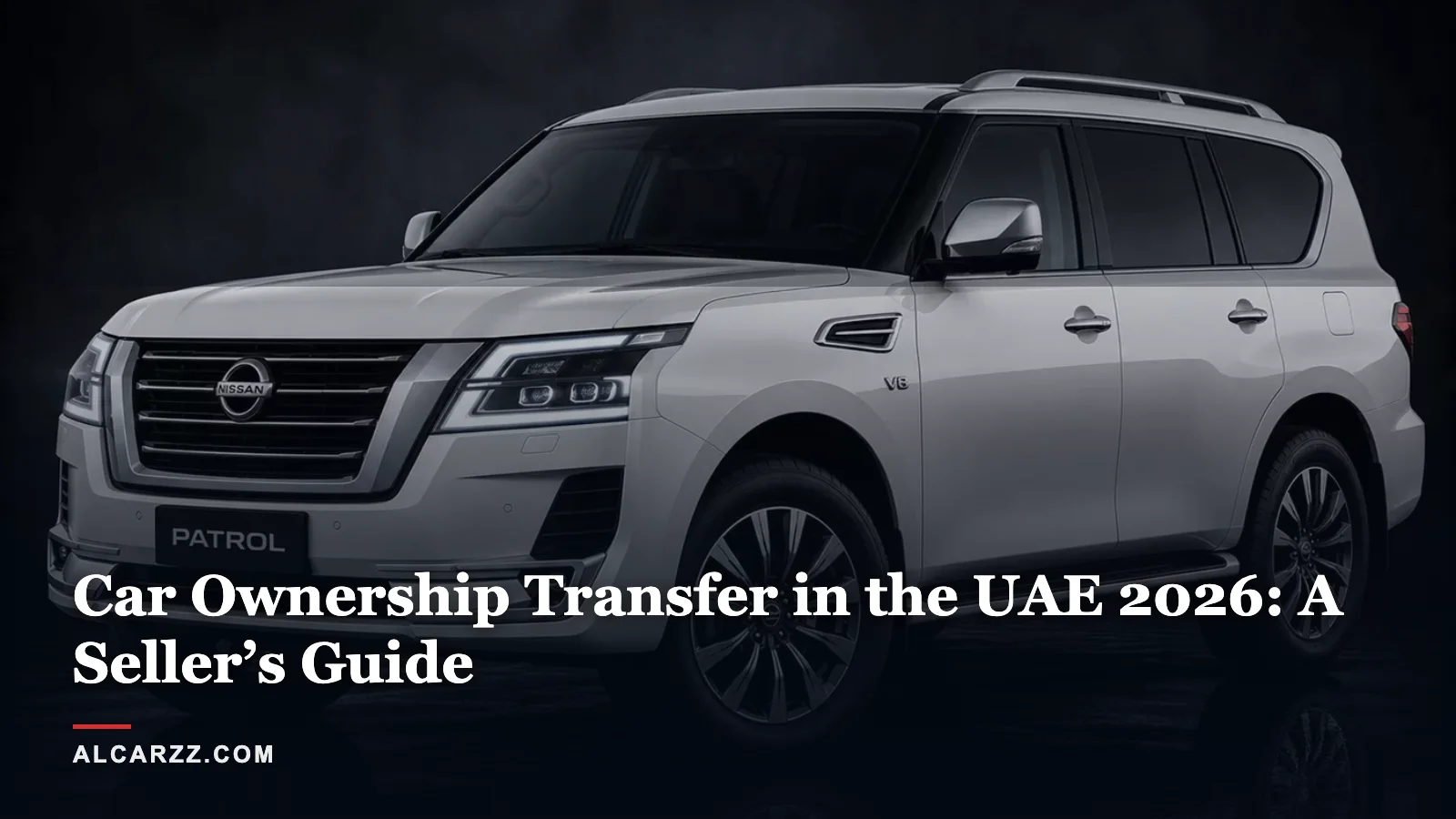
Popular models such as the Nissan Patrol, Toyota Land Cruiser and Toyota Prado move quickly in the UAE used market, which creates pressure to rush paperwork. Resist it — a fast sale that leaves you legally exposed is not a good sale.
Expert verdict
Ownership transfer in the UAE is administratively straightforward and genuinely risky at the same time. The process itself is well designed: clear documents, a modest fee, and under an hour at a service centre when everything is in order. The risk is not bureaucratic — it is behavioural. It comes from the entirely reasonable-feeling decision to hand over keys before paperwork.
Treat the new Mulkiya as the only event that matters. Money received is not transfer. A signed agreement is not transfer. Keys handed over is definitely not transfer. Until that registration card carries the buyer's name, every Salik charge, every fine and every accident is legally yours — and the AED 350 fee is trivially small compared with what a single collision during that window can cost.
Frequently asked questions
When does car ownership legally transfer in the UAE?
Ownership transfers when the RTA issues a new Mulkiya in the buyer's name. Receiving payment, signing a sale agreement or handing over keys does not transfer legal ownership or liability.
How much does it cost to transfer car ownership in Dubai in 2026?
The transfer fee is commonly quoted at AED 350, with a range of roughly AED 350–500 depending on vehicle type and weight. Additional costs include inspection at around AED 170 and number plates from approximately AED 35 to AED 500.
Who is responsible for Salik charges before the transfer completes?
The seller. Salik is linked to the vehicle and the registered owner, so every gantry the buyer passes before the new Mulkiya is issued charges the seller's linked account. Deactivate or transfer the tag as part of the transfer, not afterwards.
Can car ownership be transferred without both parties present?
As of 2026 the final transfer still requires both buyer and seller to attend, unless the absent party provides a properly notarised power of attorney. An informal authorisation letter is not sufficient.
What stops an ownership transfer from going through?
The most common blockers are unpaid traffic fines, an outstanding Salik balance, an unsettled bank loan on the vehicle, illegal modifications, expired insurance or Emirates ID, and a missing or failed inspection.
How long does the RTA ownership transfer take?
Typically 30 to 60 minutes at an RTA service centre or approved typing centre when all documents are in order. Delays are almost always caused by unpaid fines or the buyer's insurance not being arranged in advance.
Can I sell a car that still has a bank loan on it?
Not until the financing is cleared and the lender formally releases its interest in the vehicle. Begin that process before advertising the car, as it takes days rather than hours.
Related: Thinking of buying in another emirate? Count the transfer costs first — see do cars really cost less in Sharjah and Ajman?