
Toyota RAV4 vs Honda CR-V (2026): The GCC Buyer's Comparison
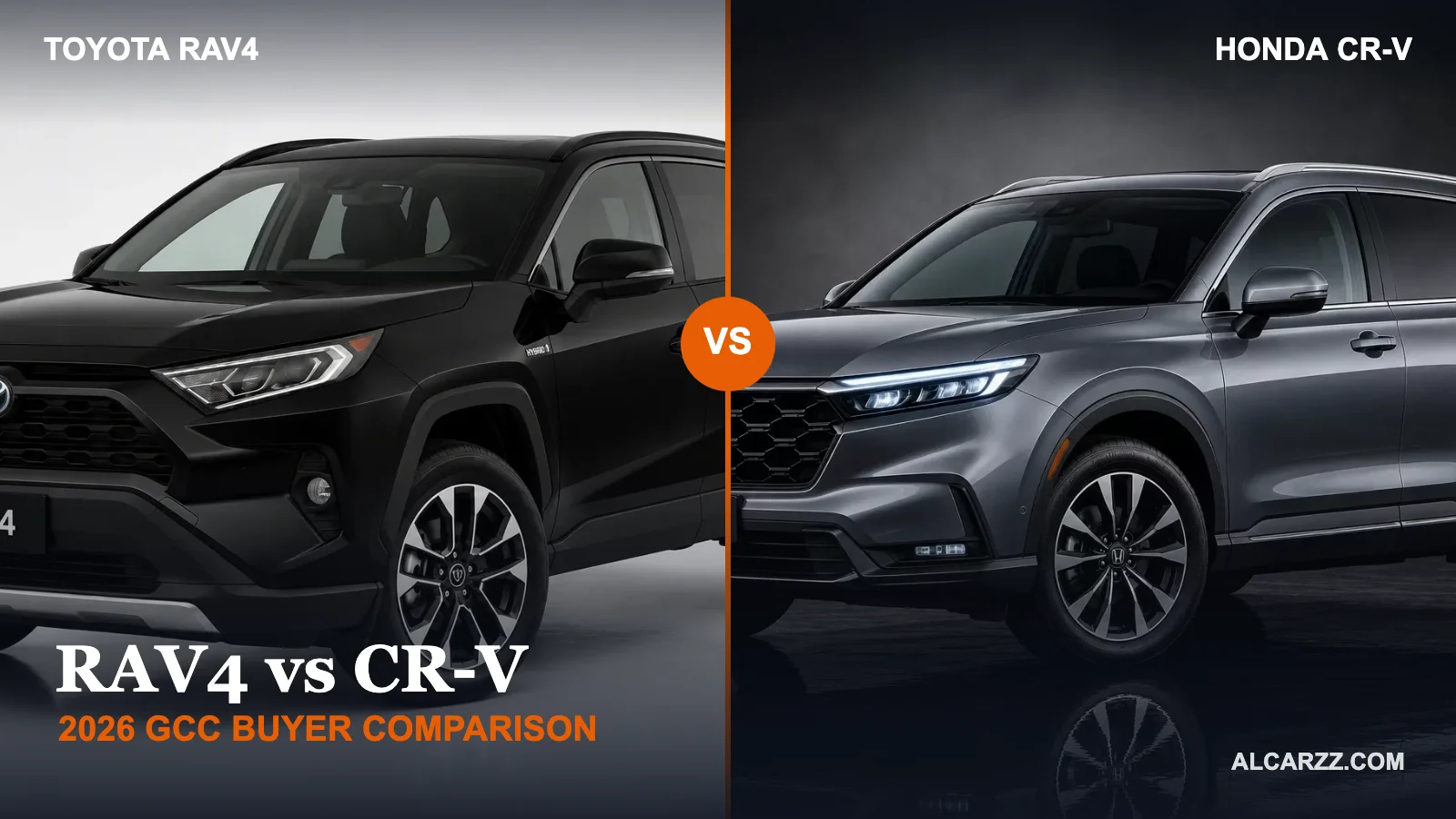
Two of the best-selling family SUVs in the Gulf, re-engineered for 2026 — one goes all-hybrid, the other keeps a turbo. Here is the honest, numbers-first breakdown for buyers in the UAE, Saudi Arabia, Qatar, Kuwait, Oman and Bahrain, plus a clear verdict on which one deserves your money.
RAV4 vs CR-V at a glance
The Toyota RAV4 and Honda CR-V have spent a decade trading blows at the top of the Gulf’s compact-SUV sales charts. For 2026 the gap is more philosophical than ever: the sixth-generation RAV4 goes fully electrified — every trim is a hybrid (HEV) or plug-in hybrid (PHEV) — while the CR-V keeps a punchy 1.5-litre turbo alongside a growing hybrid range. Short answer: the RAV4 is now the efficiency and resale champion; the CR-V is the more powerful, more comfortable everyday cruiser.
| Toyota RAV4 (2026) | Honda CR-V (2026) | |
|---|---|---|
| Starting price (UAE) | from ~AED 105,900* | from ~AED 119,900* |
| Base powertrain | 2.5L hybrid (HEV), all trims electrified | 1.5L turbo petrol; hybrid on higher trims |
| Peak power | ~219 hp (hybrid AWD) | 190 hp (1.5T) |
| Headline strength | Fuel economy, resale, hybrid range | Power, refinement, rear-seat space |
| Best for | Cost-conscious, high-mileage families | Comfort-first, long-highway buyers |
*Indicative 2026 starting prices for orientation; confirm live variant pricing on the ALcarzz UAE car prices page.
Prices in the UAE & GCC (2026)
In the UAE, the 2026 RAV4 opens near AED 105,900 while the CR-V starts around AED 119,900 — so the Toyota undercuts the Honda by roughly AED 14,000 at the entry point, and does so with a hybrid as standard. That is an unusually strong value position and a big reason the RAV4 dominates Gulf compact-SUV demand.
Pricing shifts across the GCC because of differing VAT, registration and dealer structures:
- Saudi Arabia: on-road figures include 15% VAT plus registration — budget noticeably above the sticker.
- Qatar & Kuwait: lower-tax environments, so on-road prices sit closer to list; hybrid allocation varies by importer.
- Oman & Bahrain: smaller allocations mean trim availability, not price, is often the deciding factor — order hybrids early.
Because prices move monthly, always cross-check the live figure and current offers before you commit — ALcarzz tracks these on the latest offers page, and you can estimate finance instantly with the EMI calculator.
Powertrains: all-hybrid vs turbo
Toyota RAV4 — hybrid by default
Toyota has made the RAV4 electrified-only. The core HEV pairs a 2.5-litre petrol engine with electric motors for a combined output around 219 hp, with electronic all-wheel drive on AWD versions; a plug-in (PHEV) tops the range with meaningful electric-only city range. In Gulf traffic — endless stop-start and idling in heat — the hybrid shines, recovering energy on every brake and running the AC on the battery at a standstill.
Honda CR-V — turbo now, hybrid if you want it
The CR-V’s 1.5-litre turbo makes 190 hp and 243 Nm and feels torquier and more eager than the Toyota’s base hybrid in everyday overtakes and highway merges. Honda also offers a hybrid CR-V higher up the range. If outright ease of pace matters more than the fuel bill, the turbo Honda is the more satisfying drive.
Bottom line: pick the RAV4 if efficiency and low running cost lead your list; pick the CR-V if you want stronger real-world urge and are happy to feed it petrol.
Real running cost in Gulf conditions
Sticker price is only the start. Over a typical three-year, 60,000 km GCC ownership period, the gap usually widens in the RAV4’s favour thanks to fuel and resale.
| Factor | RAV4 Hybrid | CR-V 1.5T |
|---|---|---|
| Fuel use (real-world, mixed) | Lower — hybrid advantage in traffic | Higher — turbo petrol |
| Servicing | Low; dense Toyota network | Low; competitive intervals |
| Resale after 3 yrs | Strongest in class | Strong, slightly behind |
Fuel is cheaper in the Gulf than in Europe, so a hybrid pays back more slowly here — but for high-mileage drivers, ride-hail use, or anyone commuting Dubai–Abu Dhabi or across Riyadh, the RAV4’s economy adds up fast.
Space, comfort & practicality
Both seat five in genuine comfort with different characters. The CR-V is the packaging benchmark — a roomy rear bench, flat floor and easy three-child-seat fit. The RAV4 answers with a more rugged, higher-set driving position many Gulf buyers prefer, plus a boot that swallows airport runs.
- Rear-seat space: edge to the CR-V.
- Boot practicality: both excellent; CR-V marginally more usable.
- Cabin feel: CR-V leans plush; RAV4 leans robust and SUV-like.
- AC at idle: hybrid RAV4 keeps cooling without burning fuel.
Technology & safety
For 2026 both ship with a full active-safety suite — autonomous emergency braking, adaptive cruise, lane-keeping and blind-spot monitoring on most trims (Toyota Safety Sense and Honda Sensing). Infotainment is modern on both with wireless Apple CarPlay and Android Auto on mid and upper trims. Honda’s switchgear feels a touch more premium; Toyota counters with bulletproof usability. Always confirm which driver-assist features are on the specific GCC trim you are quoted.
Reliability & resale
This is where the RAV4 pulls ahead. Toyota’s durability reputation in extreme heat, plus the densest service and parts network in the region, gives it the strongest resale value in the segment — real cash back when you sell. The CR-V is also highly reliable and holds value well; it simply sits a step behind. If you change cars every three to four years, that resale delta can outweigh the RAV4’s lower purchase price entirely.
Pros & cons
Toyota RAV4 (2026)
Pros: lower entry price with hybrid as standard; best-in-class economy in traffic; strongest resale; rugged SUV character.
Cons: base hybrid less urgent than the CR-V turbo; rear seat slightly tighter; popular trims can have waitlists.
Honda CR-V (2026)
Pros: stronger, more eager turbo; class-leading rear space; plush, refined cabin and ride.
Cons: higher starting price; base turbo thirstier than the RAV4 hybrid; resale strong but behind Toyota.
Expert verdict
For most GCC buyers in 2026, the Toyota RAV4 is the one to buy. It costs less to purchase, less to run, and returns more when you sell — a rare hat-trick — while its standard hybrid suits exactly how we drive in the Gulf. The Honda CR-V remains an outstanding SUV and is the better pick if rear-seat space and turbo refinement top your list, but it asks you to pay more to get there. Cross-shop the exact trims and compare them side by side on the ALcarzz car comparison tool before you sign.
Explore RAV4 & CR-V deals on ALcarzz →
Frequently asked questions
Is the RAV4 or CR-V better for families in the UAE?
Both are excellent. The CR-V offers slightly more rear-seat space and a plusher cabin; the RAV4 counters with lower running costs, hybrid efficiency and stronger resale. For most UAE families balancing space and long-term value, the RAV4 is the smarter overall buy.
Which is cheaper to run in the GCC?
The RAV4 Hybrid. Its electrified powertrain uses less fuel in the stop-start traffic common across Gulf cities and holds value better at resale, so total cost of ownership is typically lower than the turbo CR-V.
Does the 2026 RAV4 come only as a hybrid?
Yes. The sixth-generation RAV4 is electrified across the range — every trim is a hybrid (HEV) or plug-in hybrid (PHEV).
Is the Honda CR-V more powerful than the RAV4?
The CR-V’s 1.5-litre turbo makes 190 hp with strong torque and feels eager in everyday driving. The RAV4 hybrid produces around 219 hp combined but delivers it differently; many drivers find the CR-V turbo more immediately responsive on the highway.
Which holds value better in the UAE and Saudi Arabia?
The RAV4 typically has the strongest resale value in the compact-SUV segment across the GCC, thanks to Toyota’s reliability reputation and wide service network. The CR-V also holds value well, just a step behind.